Advanced Receive Settings
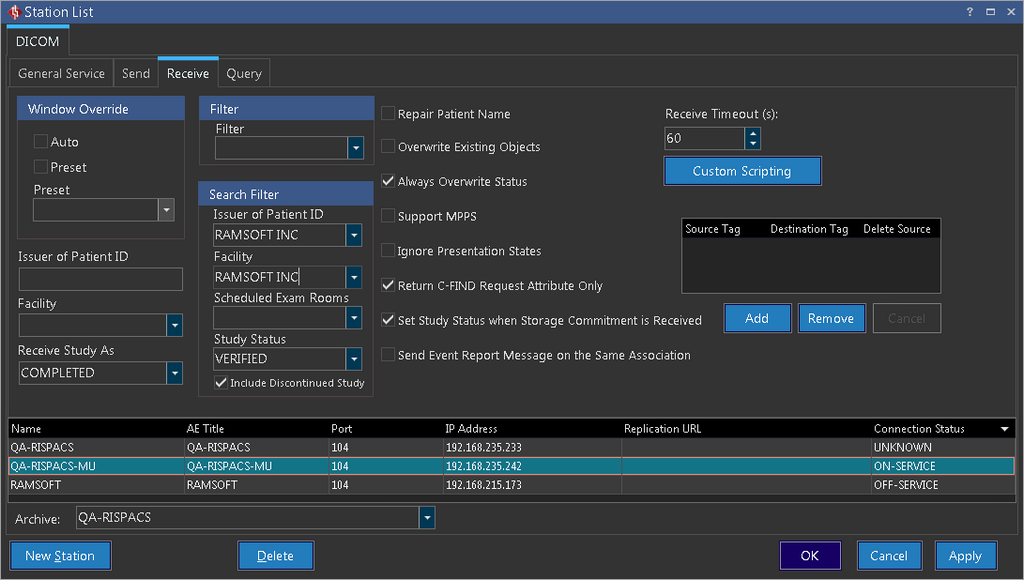
In the Receive section of the Station List you will be able to toggle options used for receiving studies from a remote destination. Any settings you toggle will only apply to studies received from the station that is currently highlighted in the list.
If the images received from a specific station are not very clear and the window/level values have to be adjusted to view them, the Window Override section can be used to automate this process. The Auto window/level, or a Preset can be automatically applied to all the images that come in from the selected station. The Auto option will automatically determine an appropriate window center and a window width based on the image histograms of all the images received from the selected station. The Preset option will automatically apply the selected window/level preset to all images.
Similarly, if the window/level values cannot be used to clean up certain images, Filters can be auto applied. For example, a smoothing filter may be applied to remove grid lines from a CR device, while a minimum filter may be applied to remove video noise from an RF device. This is done by selecting a filter from the Filter Image drop down menu.
When receiving DICOM data from institutions using different RIS/HIS numbering systems, it is important to segregate Patient IDs from the two facilities. In this situation, it is likely that the same Patient ID is used to represent different patients in the two institutions. Entering a value for the Issuer of PatientID field, will result in DICOM objects that have the Issuer of PatientID field blank or null to be populated with this value. The default value for the Issuer of PatientID (if not set specifically for this station) can be specified in Maintenance. Since this is part of the primary key field in the patient table, this patient will not be merged with another patient with the same Patient ID received from a different facility.
The Receive Study As option determines the status assigned for studies received from the station. The default value here is COMPLETED but can be changed to any other status that will better accommodate the system Workflow. Selecting the option to Always Overwrite Status will cause all incoming studies to have the status selected in the Receive Study As field no matter what their previous status was.
The Repair patient Name option will check all incoming patient names to see if they contains carats (^). If they are missing, they will be automatically placed into the name. This helps in reducing conflicts and matching up priors with existing patients.
The Overwrite Existing Objects when checked off will replace all objects when receiving objects from the station.
MPPS is a method that allows stations to receive the most up-to-date status of the study. By selecting Support MPPS, MPPS can be received from the sending station.
When the Return C-FIND Request Attribute Only option is chosen, then along with the C-FIND request, a list of datasets on the requested data are also received. The C-FIND result is returned with only the requested data while any other type of data is left out.
Storage Commitment tells the sending station what the receiving status of the studies on the receiving station is. By selecting Set Study Status when Storage Commitment is Received, study status will change from IN PROGRESS to the actual receive study status in the receiver station before the Storage Commitment has finished sending the study to the sender station.
When the Send Event Report Message On The Same Association is checked off, the receiving station will send a report about the receiving progress to the sending station. The Ignore Presentation States when checked off will prevent the receiving station from receiving Presentation States.
The Receive Timeout is in seconds and can be selected from the drop down box. The Receive Timeout starts timing when the last object of the study has been received. After the last object has been received, the study status will change from IN PROGRESS to the actual receive study status after the Receive Timeout time.
For information on the Custom Scripting button, please see the Custom Scripting section of the manual.
The Archive drop down menu is used to choose which station will the studies be sent from when using Open from Server feature.
Field mapping allows individual DICOM tags to be copied, moved or deleted when DICOM objects are received from a specific station. Typically, this feature is used to correct images from modalities that are missing or incorrectly populating crucial DICOM tags.
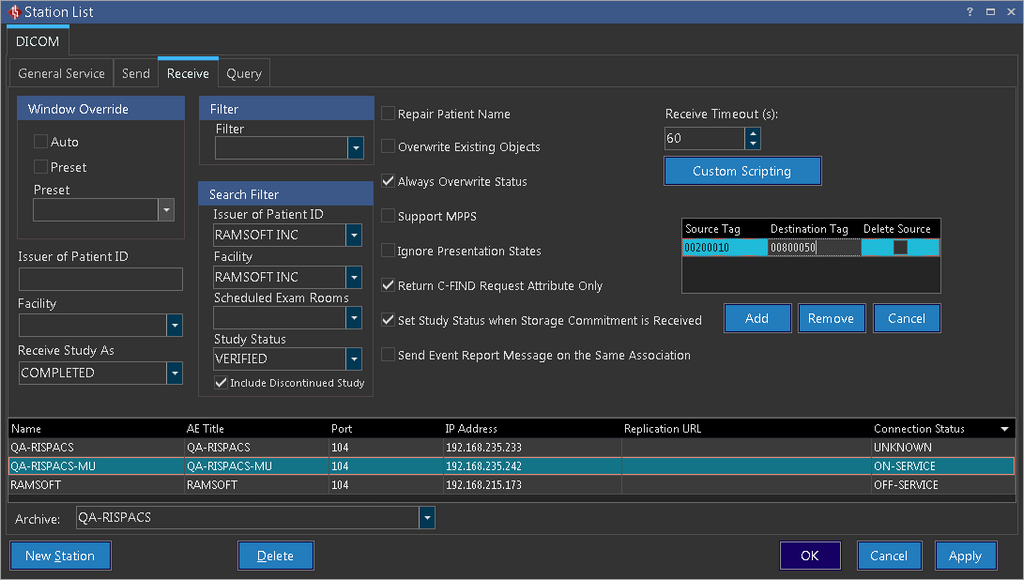
You should view the DICOM header of images received from the device that needs to be mapped prior to performing field mapping. As an example, the above entry copies the StudyID tag (0020,0010) to the AccessionNumber (0008,0050) tag. Refer to the DICOM standard for a listing of all currently approved tags.
Check the Delete Source option to remove the source tag after completing the mapping. This essentially performs a move operation instead of a copy operation.
Set the Destination value to 00000000 and check the Delete Source option to remove the source tag without performing any mapping.
Field Mapping Example
The RamSoft software relies on the Body Part tag for tasks such as configuring the hanging protocols. However, some modalities do not populate this tag, severely reducing the capabilities of the RamSoft software hanging protocols. In most cases, these modalities place the body part information in another tag. In such cases, the field mapping function can be used to automatically move the data into the proper tags. For example some modalities will place the body part information inside the Study Description tag. Prior to field mapping, a DICOM tag dictionary is needed. This dictionary can be found in the DICOM Dictionary chapter of the Service Manual. After referring to the dictionary it can be seen that the Study Description tag has the value of (0008,1030), while the Body Part tag has a value of (0018,0015).
The following screen shot illustrates how this mapping should be entered into the software for the problematic modality.

Notice that the commas and the brackets are not entered in the DICOM Tag Value. The interface simply accepts the eight digit numeric sequence for each tag. Since the Study Description tag is not causing any problems, the Delete Source option is unchecked, allowing the Study Description field to remain populated.
The Search Filter section is used to filter the search results that will be returned to a station performing a query. This is based on the values set in the different fields available in this section. The Include Discontinued Study checkbox when selected, allows studies with DISCONTINUED status to appear within the search results. For example, if there is a workstation which should only have access to studies with an issuer value of RAMSOFT and a study status of VERIFIED, those values should be selected from the drop down menus. Studies with DISCONTINUED study status would not be included in the search result because selecting VERIFIED as the desired study status will overwrite the "Include Discontinued Study" section. The resulting query results will only show studies which have these values.

Related Topics